Is Autism Hereditary and How Family Risk Works
Is autism hereditary? In many families, yes, genes play a major role in autism risk. But autism is not usually inherited in a simple one-gene, one-outcome pattern, and it is not useful to blame one parent or one side of the family. A better question is how inherited traits, new genetic changes, early development, and environment can combine. This guide explains what "genetic" and "hereditary" mean, why a child can be autistic even when parents are not, what family history can tell you, and when genetic testing may be worth discussing with a clinician. If you are reflecting on traits in yourself, a child, or a relative, a private autism traits screener can be a gentle first step for organizing observations.
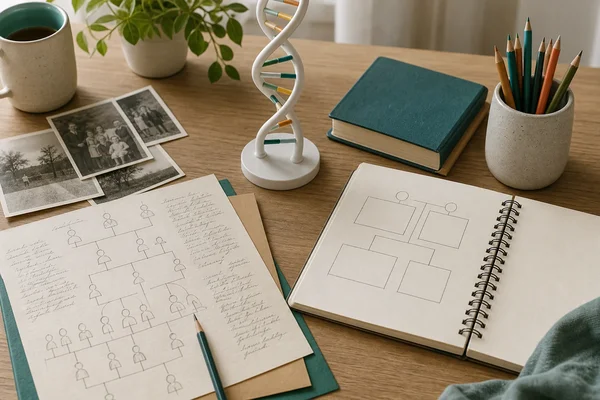
The Short Answer: Autism Can Be Hereditary, But It Is Not Simple
Autism is considered strongly influenced by genetics. Family and twin studies show that inherited genetic factors explain a large share of differences in autism likelihood across a population. Some public health summaries place genetic contribution in a broad range, while one large five-country study estimated inherited factors at about 80% of autism risk.
That number is often misunderstood. It does not mean that 80% of one person's autism comes from DNA and 20% comes from something else. Heritability describes variation across groups of people, not a precise recipe for an individual. It also does not mean autism is "only hereditary." Some genetic changes are inherited, some arise for the first time in a child, and many small genetic differences may combine with early developmental conditions.
"Genetic" and "hereditary" are related but not identical. Genetic means DNA is involved. Hereditary means a genetic influence can be passed through families. Autism can be genetic without always being clearly hereditary, especially when a new DNA change appears in egg, sperm, or early embryo development. It can also be hereditary without following a predictable pattern like some single-gene conditions.
This is why family history matters, but it is not a verdict. A parent, sibling, aunt, uncle, or grandparent may show related traits, have ADHD, need strong routines, avoid certain sensory experiences, or struggle with subtle social communication. Those patterns can help a clinician understand context. They cannot, by themselves, tell anyone whether a child will or will not be autistic.
For adults who are trying to sort family patterns from present-day traits, an AQ-50-style self-screening experience can help gather examples before deciding whether to seek a fuller professional evaluation.
Who Carries Autism-Related Genes: Mother, Father, or Grandparents?
Searches like "who carries the autism gene mother or father" are common because families want a clear answer. The honest answer is that there is no single autism gene for most people. Autism-related genetic influence can come from the mother, the father, both parents, or neither parent in an obvious way.
Each parent passes on many DNA variants. Most individual variants have small effects, and many people who carry autism-associated variants are not autistic. In some families, a parent may have subtle traits but never had a clinical label, especially if they grew up when autism was less recognized in adults, women, or people with lower support needs. In other families, there may be no visible pattern at all.
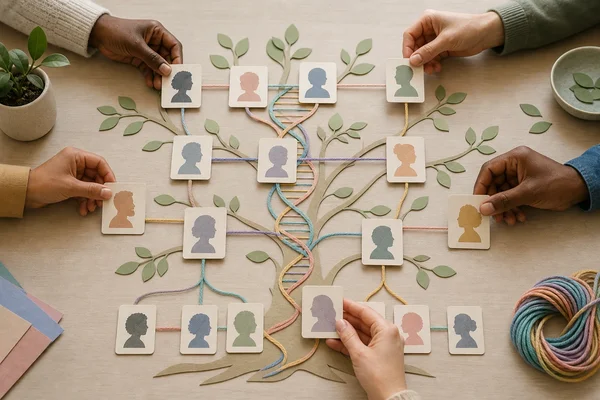
Grandparents can matter because inherited variants move through generations. If several relatives across generations share sensory sensitivities, intense interests, literal communication, social fatigue, ADHD, learning differences, or a strong preference for routine, that pattern may be relevant. But a grandparent does not need to be autistic for a grandchild to be autistic. Family trees are clues, not calculators.
A child can also be autistic when both parents seem neurotypical. This can happen because many small inherited variants combine in a child in a way that crosses a threshold, because a new DNA change occurs, or because relatives' traits were mild, masked, or never formally assessed. It is more accurate to think in terms of probability and developmental pathways than in terms of one person "carrying autism."
Is Autism Only Hereditary, or Can Pregnancy Factors Matter?
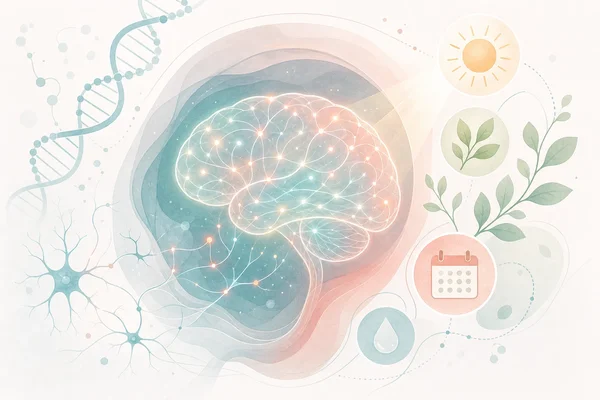
Autism is not only hereditary. Research points to a complex mix of genes, early brain development, and environmental or prenatal factors. This does not mean parents caused autism. It means scientists study conditions that may be associated with higher or lower likelihood across large groups.
Factors often discussed in research include older parental age, very low birth weight, birth complications involving oxygen deprivation, some prenatal exposures, maternal immune or metabolic conditions, and certain genetic syndromes such as Fragile X syndrome. These are associations, not guarantees. Many children with these factors are not autistic, and many autistic people do not have any known prenatal factor.
The phrase "what causes autism during pregnancy" can be misleading because autism rarely has one simple cause. Early brain development is shaped by many biological processes before birth. Some factors may influence risk in people who already have genetic susceptibility. Others may be markers for broader developmental conditions rather than direct causes.
This is also why guilt-heavy explanations are unhelpful. Parents usually cannot trace autism to one meal, one stressful week, or one ordinary decision. A more useful approach is to focus on current needs: communication support, sensory accommodations, learning style, social expectations, daily routines, and access to qualified professional guidance when concerns are significant.
Is High-Functioning Autism Hereditary?
"High-functioning autism" is a phrase many people still use, although it can be imprecise. Some use it to mean lower visible support needs, average or above-average language ability, or what was once called Asperger's syndrome. The genetic picture is still complex. People with fewer visible support needs can have hereditary autism-related traits in their families, just as people with higher support needs can.
The label does not make autism more or less hereditary by itself. What may change is whether family patterns are noticed. In some families, relatives with lower support needs may have built careers around deep focus, avoided overwhelming social settings, or developed strong routines that made traits less visible to others. That can lead people to recognize family patterns only after a child or adult starts asking questions.
ADHD can add another layer. Autism and ADHD often co-occur, and research suggests overlapping genetic influences for several neurodevelopmental traits. But ADHD in a parent does not automatically predict autism in a child, and autism in one family member does not mean every relative has the same profile. It is better to document specific patterns: attention regulation, sensory sensitivity, repetitive behaviors, communication style, executive function, and emotional regulation.
If you are exploring traits in an adult family member, look beyond stereotypes. Some adults maintain eye contact, have friendships, or succeed at work while still experiencing exhaustion from masking, sensory overload, social confusion, or rigid routines. Heredity can show up as repeated patterns, not identical lives.
Genetic Testing for Parents: What It Can and Cannot Tell You
Genetic testing can be useful in some autism evaluations, especially when there are developmental delays, intellectual disability, seizures, unusual physical features, a known family syndrome, or other medical concerns. Tests may look for chromosomal copy-number changes, Fragile X syndrome, or other genetic findings that can guide medical care and family counseling.
However, genetic testing does not explain autism for everyone. Many autistic people will not receive a clear genetic finding. A result may be negative, uncertain, or relevant to broader health care rather than a complete explanation of autistic traits. Testing also cannot reliably predict exactly how a child will communicate, learn, socialize, or need support.
Parents considering genetic testing may want to ask a clinician or genetic counselor:
- What question is this test meant to answer?
- What kinds of results are possible?
- Could results affect medical care, therapy planning, or family planning?
- How are uncertain findings handled?
- Should parents or siblings be tested too?
- What privacy and insurance issues should we understand?
For adults, genetic testing may be less central unless there are medical features that make it relevant. A clinical autism assessment usually focuses on developmental history, current traits, functional impact, and co-occurring needs. Genetics can add information in some cases, but it is not the whole story.

How to Use Heredity Information Without Jumping to Conclusions
The best use of heredity information is to make observation more thoughtful. Instead of asking, "Who is responsible?" ask, "What patterns appear in our family, and what support would help now?" That shift lowers blame and makes the information more useful.
Start with a simple family-and-traits note. Write down autism-related patterns, ADHD, learning differences, speech or language history, sensory sensitivities, strong routines, social burnout, anxiety, sleep issues, seizures, and known genetic conditions. Add ages, examples, and whether the trait affected school, work, relationships, or daily life. If a child is being evaluated, include early milestones and current strengths as well as challenges.
Then separate three questions:
- What traits are present right now?
- What support would improve daily life?
- What family or medical history should a professional know?
This structure is useful even if no one else in the family is autistic. It keeps the focus on lived experience instead of certainty. If someone is looking for a low-pressure way to organize current traits before a professional conversation, an educational autism self-reflection tool can help frame observations without replacing clinical care.
Autism is hereditary in many families, but heredity is not destiny. It is one part of a larger developmental picture that includes biology, environment, family history, and the supports a person receives over time.
FAQ
Can a child be autistic if the parents are not?
Yes. A child can be autistic even if neither parent identifies as autistic. This may happen because many small inherited variants combine in one child, because a new genetic change occurs, or because relatives' traits are subtle or unrecognized.
Can two neurotypical parents have an autistic child?
Yes. Neurotypical parents can have an autistic child. Autism risk is influenced by many genetic and developmental factors, and the absence of a clear family pattern does not rule out autism.
Does autism usually run in families?
Autism often runs in families, but the pattern may be uneven. One family may have several autistic relatives, another may have ADHD or sensory traits, and another may have only one autistic person with no obvious family history.
Is autism hereditary from mother or father?
Autism-related genetic influence can come from either parent, from both parents, or from a new genetic change. For most families, it is not accurate to say that only the mother or only the father "carries" autism.
Can autism be hereditary from grandparents?
Grandparents can pass along genetic variants that are part of a family's autism-related risk, but that does not mean a grandparent must be autistic. Grandparent history is most useful as one piece of a larger family pattern.
Is high-functioning autism hereditary?
It can be. People with lower visible support needs may still share inherited autism-related traits with relatives. The phrase "high-functioning" does not make the genetics simple, and support needs can change by setting and life stage.
What are 12 signs of autism in adults?
Adult signs can include social fatigue, difficulty reading subtext, sensory sensitivity, intense interests, strong routines, distress with change, repetitive movements, literal communication, masking, shutdowns after overload, trouble with small talk, and executive function challenges. These signs are not proof on their own; they are reasons to reflect and, if needed, seek qualified guidance.