After Your Autism Test: Practical Strategies for Daily Life
Receiving your autism test results can bring a mix of emotions. You might feel a sense of relief, confusion, or perhaps you have even more questions than before. Whether you scored high or are simply seeking clarity, the period between an initial screening and a professional evaluation can feel like a waiting game. What should you do with this new information?
This guide provides actionable, non-diagnostic strategies to help you navigate daily challenges while you consider your next steps. From managing sensory sensitivities to improving social communication, these evidence-based approaches can make your journey toward self-understanding more manageable. If you haven't yet seen your score, you can start the test to begin your journey of discovery today.
Our goal is to help you bridge the gap between curiosity and clarity. By using the right tools and strategies, you can begin to accommodate your unique needs immediately.
Understanding Your Test Results and Next Steps
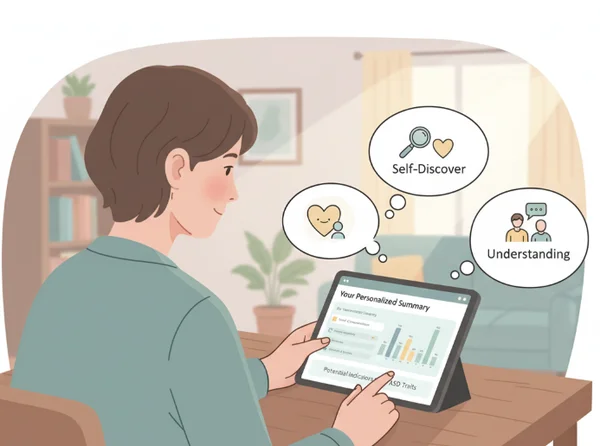
The first thing to remember is that an online screening is a starting point, not a destination. Tools like the Autism Spectrum Quotient (AQ) are designed to identify traits that are common among people on the spectrum. However, they do not provide a medical diagnosis. Instead, they act as a mirror, reflecting your behavioral patterns and cognitive styles.
What Your Score Indicates About Potential Traits
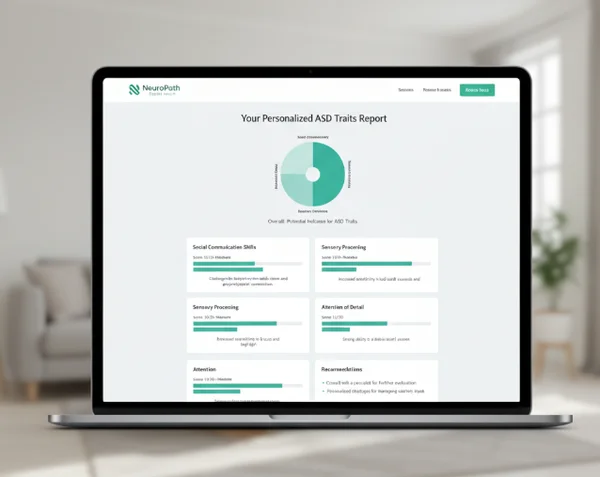
When you complete an online autism test, your score usually focuses on several key areas. These often include social communication, attention to detail, and sensory processing. A high score suggests that you share many characteristics with the autistic community. It might explain why certain social situations feel draining or why you notice patterns that others miss.
Prioritize reviewing "sub-scores" if they are available. For example, you might score very high in sensory sensitivity but lower in social challenges. This nuance helps you understand your specific profile. Many users find that our AI-powered reports offer a deeper level of detail than a simple number. Understanding these traits allows you to stop blaming yourself for "struggling" and start looking for the right support.
When and How to Seek Professional Evaluation
If your screening results indicate significant autistic traits, you may want to seek a formal clinical diagnosis. A psychologist, psychiatrist, or neurologist typically conducts professional evaluations. They use tools like the ADOS-2, the "gold standard" for autism assessments, to provide clarity.
Consider a professional evaluation if your traits significantly impact your quality of life, employment, or relationships. A formal diagnosis can unlock access to workplace accommodations, specialized therapy, and government support. To prepare for this, keep a copy of your test results and a journal of your daily experiences. This documentation will be incredibly helpful when you sit down with a specialist.
Building Your Sensory Toolkit for Everyday Life
Many adults who discover their neurodivergence later in life report a common realization: they’ve been coping with constant sensory overload. Identifying triggers can help manage this. Building a sensory toolkit is one of the most effective ways to manage stress. It involves identifying what "triggers" you and finding ways to dampen those inputs.
Creating Sensory-Friendly Spaces at Home and Work
Your environment plays a massive role in your mental energy. If you often feel irritable or exhausted, your surroundings might be too loud or too bright. Start by evaluating your home and workspace. Can you switch harsh overhead fluorescent lights for warm, dimmable lamps? Reducing visual clutter can also lower "background" anxiety for your brain.
In a work environment, you might ask for a desk in a quiet corner or use a privacy screen. Small changes, like using a weighted lap pad while working or keeping a soft-textured object nearby, can provide grounding. If you are a parent helping a child, creating a "calm down corner" with pillows and low lighting can prevent sensory meltdowns before they start.
On-the-Go Sensory Regulation Techniques
The world outside your home is often unpredictable and loud. To manage this, you need a portable sensory toolkit. This doesn't have to be complicated. Many adults carry noise-canceling headphones or high-quality earplugs to manage sudden loud noises in public transport or malls.
Other helpful items include:
- Fidget tools: Small items you can spin or click to help focus your nervous energy.
- Sunglasses: To reduce the strain of bright sunlight or harsh indoor lighting.
- Scented oils: For some, a familiar scent like lavender can provide an instant sense of safety during a panic attack or sensory spike.
Feeling overwhelmed in public? The ‘5-4-3-2-1’ grounding technique can help: Name five things you see, four things you can touch, and so on. This pulls your brain out of a sensory loop and back into the present moment.

Communication Strategies for Social Settings
Social interaction is often cited as the most exhausting part of the day for neurodivergent individuals. This is often due to "masking"—the act of suppressing your natural traits to fit in. While masking can be a survival tool, it leads to intense burnout. Learning new communication strategies can help you interact more authentically.
Scripts for Navigating Difficult Conversations
One of the best ways to reduce social pressure is to have "scripts" ready for common situations. A script is a pre-planned sentence that handles a social "bottleneck" without requiring you to think on your feet. For example, if you need to leave a social gathering because you are tired, you don't need a long excuse.
You can use simple phrases like:
- "I’ve had a great time, but I’ve reached my social limit for today. I'm going to head home now."
- "I need a moment to process that information. Can I get back to you in an hour?"
- "The noise in here is a bit much for me. Can we move to a quieter spot to talk?"
By using these scripts, you set clear boundaries. People who care about you will appreciate the clarity. If you are unsure about your social patterns, you can use our tool to see how your communication style compares to common ASD traits.
Reducing Social Anxiety Through Preparation
Anxiety often stems from the unknown. You can lower your stress levels by "pre-gaming" social events. This means researching the venue beforehand to check for noise levels or exits. It also means setting a "time limit" for how long you will stay. Knowing you can leave after one hour makes the hour much easier to handle.
If you are attending a meeting, ask for an agenda in advance. This allows you to prepare your thoughts so you aren't surprised by a sudden question. Preparation isn't about being "perfect"; it's about reducing the cognitive load on your brain. When you spend less energy worrying about the "what ifs," you have more energy to actually enjoy the interaction.
Your Journey Continues Beyond the Test
Taking an autism test is a brave first step toward self-discovery. It marks the transition from wondering why you feel "different" to understanding the unique way your brain is wired. Remember, being on the spectrum isn’t a problem to solve—it’s a different way of experiencing the world, with unique strengths and challenges.
As you move forward, focus on self-compassion. Use the strategies we discussed to accommodate your sensory needs and protect your social energy. Whether you choose to pursue a formal diagnosis or simply use this information for personal growth, you are now better equipped to build a life that works for you.
For deeper insights, consider exploring your personalized AI report—a tool many users find invaluable for understanding their unique traits. Your journey is just beginning, and understanding is the key to thriving.
What if my autism test score is high?
If your score is high, don't panic. A high score simply means you have many traits associated with the autism spectrum. Your first step should be to learn more about these traits and see if they resonate with your life history. Many people find it helpful to join online communities or read books by autistic authors. If the traits interfere with your daily life, we recommend sharing your results with a healthcare professional to discuss a formal evaluation.
How can I manage anxiety while waiting for a professional evaluation?
Waiting for a clinical appointment can take months, which often causes anxiety. During this time, focus on "self-accommodation." Act as if you already have the diagnosis and start implementing sensory and social supports. Reducing your daily stress through the strategies mentioned in this article can lower your overall anxiety. Remember that your experiences are valid, even without an official piece of paper. You can also check our homepage for more articles on neurodivergent mental health.
Are these strategies helpful even if I don't have autism?
Yes, absolutely. Many of these strategies—such as sensory regulation, using scripts, and setting social boundaries—are beneficial for people with ADHD, social anxiety, or sensory processing disorder. They are "human-friendly" strategies. Even if you don't meet the full criteria for an autism diagnosis, if these tools improve your quality of life, you should continue using them. The initial screening is simply a tool to help you find the best way to support your mental well-being.