Are Online Autism Tests Accurate? Screening vs. Diagnosis
The internet offers a world of information at our fingertips, and with it, a plethora of quizzes and tests promising quick insights into our personalities and health. Among these, online autism tests have become increasingly popular. But this accessibility raises a critical question: Are online autism tests accurate? If you're exploring whether you or a loved one might have autistic traits, you need a clear, trustworthy answer. This article will cut through the confusion, explaining the vital difference between an online screening and a formal clinical diagnosis, and show you how to use tools like our online screening platform as a responsible and empowering first step on your journey of understanding. For a reliable starting point, you can explore your traits now.
Understanding Online Autism Screeners: Their Role & Value
Before we can discuss accuracy, we must first understand what an online autism test truly is. Most are not "tests" in the sense of providing a definitive yes-or-no answer. Instead, they are screeners—tools designed to identify the potential presence of certain traits or characteristics associated with Autism Spectrum Disorder (ASD). They are the beginning of a conversation, not the end.
What is an Autism Screener and How Does it Work?
An autism screening tool is a questionnaire that asks about your experiences related to social communication, sensory sensitivities, patterns of behavior, and specific interests. When you complete a screener, it calculates a score based on your answers. This score indicates whether you have a higher or lower number of traits commonly associated with autism.
Think of it like a preliminary survey. It doesn't dig into the nuances of your personal history or observe your behavior in different contexts. It simply gathers self-reported data to provide a snapshot. The process is straightforward: you answer a series of questions, and the system provides immediate feedback, helping you see patterns you may not have noticed before.
The Science Behind Tools like the AQ Test
Reputable screeners aren't just random questions. Many, including our AQ-inspired screener, are inspired by scientifically validated instruments like the Autism-Spectrum Quotient (AQ) test. The AQ test was developed by researchers at the University of Cambridge to measure the extent of autistic traits in adults.
This scientifically-backed foundation ensures the questions are relevant and targeted at key areas of neurodivergence. By using a structured, evidence-inspired framework, these screeners offer much more than a simple internet quiz. They provide a structured way to self-reflect on your experiences and compare them to recognized autistic characteristics.
The Limits of Online Tests: What They Cannot Do
While screeners are valuable, their limitations are just as important to understand. Recognizing what these tools cannot do is essential for using them responsibly and avoiding misinformation. Their greatest value comes from being a guide, not a judge.
Why Online Tests Are Not Diagnostic Tools
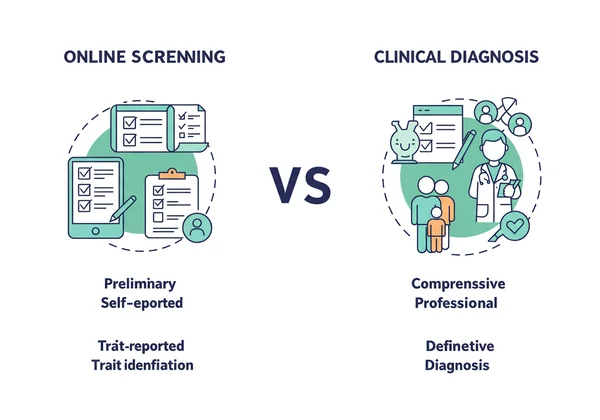
This is the most critical distinction: an online screening is not a clinical diagnosis. A formal diagnosis of Autism Spectrum Disorder can only be made by a qualified healthcare professional, such as a clinical psychologist, psychiatrist, or neurologist.
A clinical evaluation is a comprehensive process that involves much more than a questionnaire. It includes detailed interviews about your developmental history (from childhood to the present), direct behavioral observations, and often input from family members or partners. A clinician assesses the full context of your life, ruling out other conditions that might present with similar traits, like anxiety disorders, ADHD, or trauma. An online tool simply cannot replicate this depth of analysis.
Common Misconceptions About Online Autism Assessments
One of the biggest misconceptions is that a high score on an online screener automatically means you are autistic. A high score is simply an indicator that you share many traits common in autistic individuals. It is a strong signal that further exploration with a professional could be beneficial.
Another common misinterpretation is viewing the score as a measure of severity. These screeners don't measure "how autistic" you are. Autism is a spectrum of diverse experiences, and a screener's score is just one data point. It cannot capture your unique strengths, challenges, or the ways you may have learned to "mask" your traits over the years. Using the results from our online autism test as a starting point for discussion is the most effective approach.
The Professional Autism Diagnosis: A Comprehensive Approach
If an online screener suggests you might have autistic traits and this resonates with your life experiences, the next step is to consider a professional assessment. This process is the "gold standard" for understanding your neurotype.
Who Can Provide a Formal Autism Diagnosis?
A formal diagnosis must be conducted by a licensed professional with expertise in neurodevelopmental conditions. This typically includes:
- Clinical Psychologists: Specialists in mental and behavioral health who are trained in diagnostic assessment.
- Psychiatrists: Medical doctors who specialize in mental health and can also prescribe medication.
- Neurologists: Doctors who specialize in the brain and nervous system.
- Developmental Pediatricians: For children and adolescents.
These professionals use standardized diagnostic criteria from manuals like the DSM-5 (Diagnostic and Statistical Manual of Mental Disorders) to ensure a thorough and accurate evaluation.
What to Expect During a Clinical Autism Assessment
A comprehensive assessment is an in-depth exploration of you as a person. It's a collaborative process that may unfold over several sessions. You can generally expect:
-
Detailed Interviews: You'll discuss your social and communication styles, sensory experiences, interests, and how you navigate daily life. You'll also be asked about your childhood and developmental milestones.
-
Standardized Questionnaires: You may fill out more detailed versions of the screeners you found online.
-
Observational Assessments: The clinician will observe your interaction and communication patterns during your sessions. Sometimes, specific structured activities, like the ADOS-2, are used.
-
Feedback Session: After gathering all the information, the clinician will meet with you to discuss their findings, provide a diagnostic conclusion, and recommend next steps or support resources.

Bridging the Gap: Your Next Steps After an Online Test
You've taken an online test. Now what? The results are not a label but a key—a tool to unlock deeper self-understanding and guide your next actions.
Interpreting Your Screening Results Responsibly
When you receive your results from our personalized analysis tool, see them as a compass. If your score is high, it points you in a direction for further learning. Ask yourself: Do these results align with my life experiences? Does this framework help explain challenges I've faced or strengths I possess?
This is where our optional AI-powered personalized analysis can be incredibly helpful. It goes beyond a simple number to provide a personalized report that helps contextualize your results, highlighting potential strengths and challenges and suggesting areas for further reflection. This is a powerful step in transforming data into meaningful insight.
When and How to Seek Professional Evaluation
It may be time to seek professional help if your screening results resonate strongly with you and you feel that certain traits are significantly impacting your quality of life, relationships, or work.
To find a professional, you can:
- Ask your primary care physician for a referral.
- Search online directories for psychologists or clinics specializing in adult autism assessments.
- Contact local autism advocacy or support groups for recommendations.
Your online screening results can be a valuable document to bring to your first appointment, helping you articulate your concerns and giving the clinician a clear starting point. To get initial insights, start with our free screener today.

The Bottom Line
So, are online autism tests accurate? The answer is nuanced. They are highly accurate at what they are designed to do: screen for traits. They serve as an accessible, pressure-free first step to explore your neurotype. They are not, however, accurate as diagnostic tools.
A reliable screener like the one on our platform is a valuable guide on your journey of self-discovery. It can validate your feelings, provide a new language to describe your experiences, and empower you with the confidence to seek a professional evaluation if you choose. Use it as a starting point, a catalyst for learning, and a responsible step toward understanding yourself more deeply. Start your test today to begin your exploration.
Frequently Asked Questions About Autism Screening & Diagnosis
Are online autism tests truly accurate?
Online autism tests are accurate as screening tools. They reliably indicate the presence of autistic traits based on self-reported information. However, they cannot provide a clinical diagnosis and are not a substitute for a comprehensive evaluation by a qualified professional.
What's the difference between an online autism screening and a professional diagnosis?
An online screening is a brief questionnaire that provides a preliminary score indicating autistic traits. A professional diagnosis is a thorough, multi-faceted evaluation conducted by a clinician that includes interviews, observation, and a review of your developmental history to provide a definitive diagnostic conclusion.
What should I do if I score high on an online autism test?
A high score is a prompt for self-reflection and further research. Consider how the results align with your life experiences. You can use this information as a basis for a discussion with a mental health professional. Taking our free screener is an excellent way to gather initial information to share.
How do professionals test for autism?
Professionals use a combination of methods, including detailed clinical interviews about your entire life, direct observation of social and communication skills, and standardized assessment tools like the ADOS-2. They gather comprehensive information to make an informed and accurate formal diagnosis.