Adult Autism Test: Is It Autism or ADHD? Key Signs & Differences
Do you ever feel like your brain is wired differently? Perhaps you find social situations draining, yet you also struggle to focus on tasks that don't intensely interest you. You are not alone. Many adults confuse the traits of Autism Spectrum Disorder (ASD) and Attention-Deficit/Hyperactivity Disorder (ADHD) because they can look surprisingly similar from the outside. The crucial question is, how can you tell the difference between autism and ADHD?
This guide will help you understand the core signs of each condition in adults, explore the surprising overlaps, and introduce the concept of having both (AuDHD). Gaining this clarity is a powerful move toward self-understanding. If you're looking for a starting point on your journey of discovery, you can take the first step with a reliable online screening.
Understanding Key Adult Autism Signs
Autism Spectrum Disorder (ASD) is a neurodevelopmental condition that primarily affects social communication, interaction, and sensory processing. While often diagnosed in childhood, many individuals, especially those with high-functioning autism, may not recognize their traits until adulthood. The presentation can be subtle and is often internalized.
Social Communication and Interaction Challenges
For many autistic adults, social interactions can feel like they are trying to follow a complex script that everyone else instinctively knows. This isn't due to a lack of desire for connection, but rather a different way of processing social cues. Challenges may include difficulty interpreting body language, sarcasm, or unspoken rules of conversation, leading to social anxiety or exhaustion.
Repetitive Behaviors and Special Interests
Consistency and routine are often deeply comforting for autistic individuals. This can manifest as repetitive physical behaviors (stimming), such as hand-flapping or rocking, which help regulate emotions and sensory input. Furthermore, autistic adults often develop deep, passionate special interests in specific subjects, dedicating significant time and energy to learning everything about them.
Sensory Sensitivities and Overload
The world can feel like a very loud place for someone with ASD. Sensory sensitivities mean an autistic individual might be hypersensitive (overly responsive) or hyposensitive (under-responsive) to sights, sounds, smells, textures, or tastes. Bright fluorescent lights might be physically painful, or the hum of a refrigerator could be distracting, leading to sensory overload and the need to withdraw. If this sounds familiar, an online autism screening test can offer initial insights.
The Importance of Routine and Structure
Unexpected changes can be highly distressing for an autistic adult. A predictable routine provides a sense of safety and control in a world that can often feel chaotic and overwhelming. This might look like eating the same meal for breakfast every day, taking the exact same route to work, or feeling intense anxiety if plans are suddenly altered.
Identifying Common Adult ADHD Symptoms
ADHD is another neurodevelopmental condition, but its core challenges revolve around executive functions—the brain's self-management system. This impacts attention, impulse control, and emotional regulation. In adults, the hyperactivity seen in children often transforms into a persistent feeling of internal restlessness.
Inattention and Executive Function Difficulties
This is more than just occasional forgetfulness. For an adult with ADHD, inattention can mean struggling to stay focused during meetings, losing track of conversations, or being unable to complete projects that require sustained mental effort. Difficulties with executive functions also lead to challenges with organization, time management, and prioritizing tasks.
Hyperactivity and Restlessness
While adults with ADHD might not be climbing the furniture, hyperactivity persists internally. It can manifest as a constant need to fidget, an inability to sit still through a movie, excessive talking, or a feeling that you are always "on the go." This internal restlessness can be exhausting and make relaxation feel impossible. Do you want to explore these traits further?
Impulsivity and Emotional Dysregulation
Impulsivity in adults with ADHD can lead to making hasty decisions without considering the long-term consequences, such as impulse buying or abruptly quitting a job. This is often tied to emotional dysregulation, where emotions are felt very intensely and can shift rapidly. Small frustrations can quickly escalate into significant anger or distress, making relationships challenging.
"Rejection Sensitive Dysphoria" (RSD) Explained
Though not a formal diagnosis, Rejection Sensitive Dysphoria is a concept widely recognized in the ADHD community. It describes an extreme emotional sensitivity and pain triggered by the perception of being rejected, teased, or criticized. This can lead to intense people-pleasing behaviors or, conversely, social avoidance to prevent any possibility of perceived rejection.
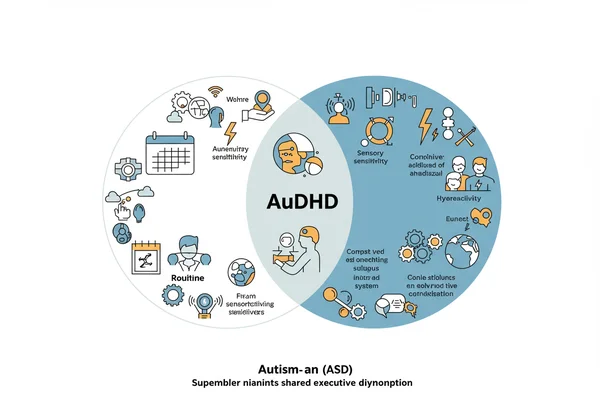
The ADHD and Autism Overlap (AuDHD) Explained
Here is where things get complicated, and why so many adults are confused. Autism and ADHD not only share many similar-looking traits but can also co-occur—a combination often referred to as AuDHD. Understanding the nuances is key to true self-awareness.
Shared Challenges: Executive Function and Emotional Regulation
Both autistic adults and those with ADHD can struggle mightily with executive functions like planning and organization. Both can also experience intense emotions and have difficulty regulating them. However, the root cause often differs. For an autistic person, emotional distress may stem from sensory overload or a broken routine, while for someone with ADHD, it might be triggered by frustration or perceived rejection.
Social Differences: Misinterpretation vs. Inattention
An autistic person might struggle socially because they misinterpret non-verbal cues. In contrast, someone with ADHD might struggle because they get distracted during a conversation, interrupt others impulsively, or miss details due to inattention. The outcome—social difficulty—looks similar, but the internal experience is quite different.
Focus: Hyperfocus (ADHD) vs. Special Interests (Autism)
Both conditions involve intense focus, but again, the nature differs. ADHD hyperfocus is a state of deep concentration, often on a novel and stimulating task, but it can be difficult to control or direct. An autistic special interest is a sustained, deep passion for a particular subject that is a core part of the individual's identity and brings great joy and comfort.
A Comparison Table: Autism vs. ADHD vs. AuDHD
| Trait | Autism (ASD) | ADHD | AuDHD (Co-occurring) |
|---|---|---|---|
| Social Interaction | Difficulty interpreting social cues; prefers structured interaction. | May interrupt, overshare, or seem inattentive in conversation. | Experiences a mix of social anxiety from misinterpretation and impulsive social behavior. |
| Focus | Deep, long-term special interests provide comfort. | Intense, but often shifting, hyperfocus on stimulating tasks. | May have deep interests but struggle to sustain focus on the "boring" parts of them. |
| Routine | Thrives on predictability; change causes significant distress. | Craves novelty and stimulation; can be bored by routine. | A constant internal battle between the need for routine (autism) and the need for novelty (ADHD). |
| Sensory Input | Often hypersensitive, leading to sensory overload. | Can be sensory-seeking for stimulation or sensory-avoidant when overwhelmed. | Experiences both sensory sensitivities and a need for stimulation, which can be confusing. |
If you see yourself reflected in these descriptions, a free Autism Test can be a helpful tool for initial exploration.
Your Path to Clarity Starts with a Single Step
Untangling the threads of autism and ADHD in adulthood is a complex process. The key takeaway is not to force a label on yourself but to use these frameworks as a tool for self-compassion and understanding. Recognizing why you struggle with certain things—whether it's due to sensory overload, executive dysfunction, or social misinterpretation—empowers you to find better strategies and advocate for your needs.
This journey is about understanding your unique neurotype. The confusion you feel is valid, but you don't have to navigate it alone. Taking a scientifically-inspired online screening can provide valuable, personalized insights to guide your next steps. It's a private, accessible way to begin piecing together your personal puzzle. Start your journey here.
Frequently Asked Questions About Neurodiversity
What is the difference between an online screening and a professional diagnosis?
This is a critical distinction. An online screening, like our reliable screening tool, is an educational resource designed to identify traits associated with a condition like autism. It provides a score and initial feedback based on your answers. A professional diagnosis, however, is a comprehensive medical assessment conducted by a qualified expert (like a psychologist or psychiatrist) and is the only way to be formally diagnosed with ASD or ADHD.
How does autism present differently in females?
Autism in women and girls is often missed because it can present differently. Females are more likely to "mask" or camouflage their autistic traits to fit in socially. This involves consciously learning and mimicking social behaviors, which can be incredibly draining. Instead of overt repetitive behaviors, their special interests might be more socially "acceptable," like literature or psychology, making them harder to spot.
Can you self-diagnose autism or ADHD?
While self-diagnosis is a complex and debated topic in the neurodivergent community, it is not a substitute for a professional assessment. Many adults come to a strong self-realization after extensive research, which can be very validating. However, a professional can rule out other conditions with overlapping symptoms and provide access to official support and accommodations. If you suspect you may be autistic, a great first step is to take our Autism Test and bring the results to a conversation with a healthcare provider.